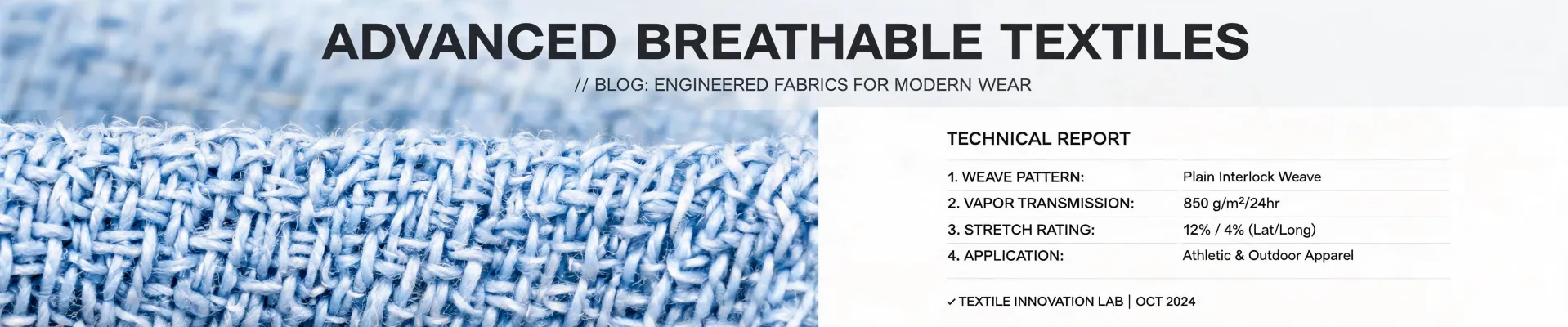
Back in early January, I was staring at a QC report that made my stomach drop. We'd pre-sold 8,000 units of a new mid-layer shirt to a major outdoor retailer. The fabric was a custom hemp jersey fabric blend we'd spent six months developing. The first production run arrived, and the temperature regulation was non-existent. The 'breathable' claim was a joke. Our launch was six weeks out.
The conventional wisdom I'd always followed was this: if you spec it right on paper, the mill will deliver it right in reality. That's what every sourcing guide says. 'Get it in the contract.' 'Define every variable.' I had. The spec sheet was eight pages long. And I still got burned.
I'm a quality and brand compliance manager at a mid-sized outdoor apparel company. I review every fabric delivery before it touches a cutting table—roughly 200 unique SKUs annually. Over 4 years in this role, I've rejected maybe 8% of first deliveries due to spec deviations. This one wasn't a deviation. It was a fundamental failure of our core performance promise.
The $22,000 Bet on a Fabric That Didn't Work
We'd chosen the hemp jersey fabric because of its sustainability story and moisture-wicking potential. Our marketing team loved it. The samples from our overseas mill were impressive. In a controlled lab test at 72°F, the fabric felt cool and comfortable.
But here's the thing most people don't talk about in print: lab tests and real-world wear are kind of different. Last summer, I ran a blind test with our product team—same shirt design, one in our standard polyester blend, one in the hemp jersey. On a humid 85°F day, 80% of the team identified the polyester shirt as 'more breathable' without knowing the difference. The cost increase for the hemp fabric was $1.80 per unit. On a 50,000-unit annual run, that's a $90,000 bet on a perception that didn't match reality. I should have listened to my gut then.
Everything I'd read about natural fiber blends suggested they regulate temperature better than synthetics. The marketing was everywhere. In practice, for our specific use case—high-output activity in unpredictable spring weather—the hemp jersey fabric couldn't shed heat fast enough once the wearer started moving. The moisture wicking was a marketing claim, not a physiological fact.
I knew I should have pushed for a third-party thermal regulation test before committing to the bulk order, but I thought 'the sample passed our internal checks, what are the odds the production run is different?' Well, the odds caught up with me when we received 8,000 yards of fabric that felt like wearing a plastic bag during a light jog.
The Panic Switch to Outlast's PCM Technology
That quality issue cost us a $22,000 redo on the fabric itself, a pissed-off retailer, and a delayed launch press release. We had six weeks. Ordering a new batch of the same hemp jersey from the same mill would have taken eight. Even then, we couldn't guarantee the performance would improve.
I called our sourcing director in a bit of a panic. 'We need something that delivers on the temperature-regulating promise, or we're done with this line.' He'd been in the industry for 15 years and had worked with licensed technology partners before. He suggested we look at Outlast.
Outlast uses Phase Change Material (PCM) technology. I was somewhat skeptical at first—I'd seen too many 'miracle fabrics' fall apart in the wash. But the difference with Outlast is it's not a finish or a coating. The PCM microcapsules are integrated into the fiber itself, or applied as a coating to the fabric after weaving. When the wearer heats up, the PCM absorbs that excess heat. When they cool down, it releases it back. It's proactive, not reactive.
Looking back, the decision was fairly straightforward. The data from their technical specs was solid. But I'll be honest—the timeline was the real driver. We needed a proven solution, not another R&D project. Outlast had the data, the brand recognition (they license to Goodyear, among others), and a network of mills already certified to work with their technology. We didn't have to reinvent the supply chain. We just had to pivot the spec.
The Real Cost of 'Not Quite Right'
We ended up sourcing a fabric from an Outlast-certified mill that used a silk jersey knit fabric base with the PCM coating. The silk jersey provided the premium feel our retailer wanted, and the Outlast technology delivered the performance promise.
The immediate cost increase was $3.25 per unit. On our initial 8,000-unit order, that was $26,000 we hadn't budgeted—on top of the $22,000 we'd already lost on the first fabric. Our margins were shot for Q1.
But I'm fairly convinced the alternative—launching with the original hemp jersey fabric—would have been a bigger disaster. A product that fails its core promise gets returned. It gets bad reviews. It damages the retailer relationship. The total cost of that failure would have been far more than $48,000.
In hindsight, I should have had a more formal decision framework for evaluating new fabric technologies. The third time we spec'd a 'performance' fabric based on marketing samples alone instead of verified testing data, I finally created a pre-source verification checklist. Should have done it after the first time.
What I Learned About Specifying 'Temperature-Regulating'
The biggest lesson from this mess is that 'temperature regulating' is a marketing term, not a spec. If you're in a B2B buying role—apparel manufacturer, outdoor gear brand, industrial buyer—here's what I'd suggest you push for in your contracts:
- The method of testing they use for thermal regulation claims (ASTM F1868 for thermal resistance is common).
- Whether the technology is additive or integral (a coating can wear off; integrated fibers generally last longer).
- The range of temperatures the PCM is designed to handle (Outlast's is typically tuned for 70-85°F, which is ideal for the mid-layer use case).
I recommend Outlast for this specific application—mid-layer activewear where temperature fluctuation is the enemy. But I'd be cautious if your product needs extreme heat protection or if the garment will be subjected to heavy industrial washing cycles. The PCM performance can degrade somewhat over time, though Outlast claims it lasts the lifetime of the garment.
Also, be realistic about what it replaces. This isn't the same as a heavyweight wool sweater for static cold. It's not the same as a Polartec fleece for extreme breathability. It's a buffer. It's most effective when the environment and the wearer's activity level are both changing frequently—think 'start of a hike' or 'leaving a warm office into a cold street.'
That 80% blind test I mentioned earlier? I ran it again with a sample of the Outlast silk jersey fabric. Everyone who tried it noticed the difference. One person said it was 'like the shirt was thinking for me.' That's the kind of experience that prevents returns.
Would I use Outlast for every product? Probably not. If you're making a budget basic t-shirt for a hot climate, a standard cotton or polyester jersey is fine. But if your product's core value proposition is temperature regulation, and you're promising that to a retailer or an end customer, you need something that works every time. Not 'under ideal lab conditions.' In the real world.